The making of a sustainable and heat-absorbing city
Masdar City's architectural philosophy works with the surrounding environment to reduce energy and water demand before technological solutions are introduced.
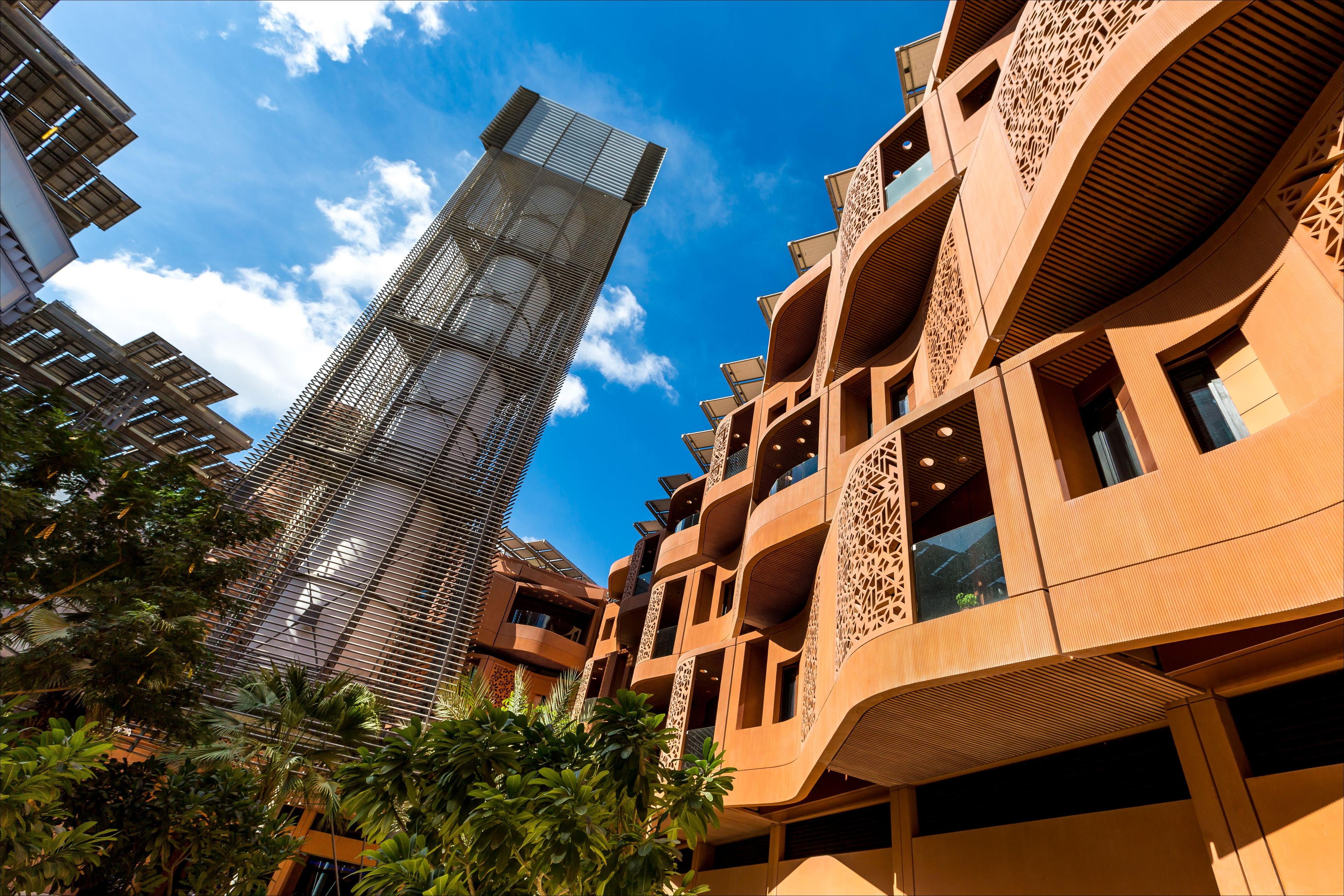 The barjeel tower is a traditional Arabian air-conditioning unit with openings at the top to capture and direct airflow to help cool buildings. Image credit: Masdar City.

Sitting under the shade of a ghaf tree in a plaza at Masdar City in Abu Dhabi, it is hard not to look up. Not because of the beautiful foliage above, but because of the towering 45-metre barjeel overhead.
An ancient architectural feature placed on top of a building, the barjeel tower, in basic terms, is a traditional Arabian air-conditioning unit. The large structure, with openings at the top, captures and directs airflow to help cool buildings.
Here, the structure, a marriage of modernity and heritage, stands as a working symbol of the city, cooling the surrounding area. Elsewhere, along walkways, buildings are laid out close enough to cast shade on those walking below, providing relief from the summer heat, with solar panels peeking out over the sides of the roofs.
Suwaid Al Badi, Associate Director of Corporate Services at Masdar City, says the entire city has been designed from the ground up with sustainability in mind. “It starts from the design,” he shares in the latest Under The Ghaf podcast episode. “It starts from the roadmap of the city itself. So you need to make sure that everything is connected.”
Central to this approach is passive design, an architectural philosophy that works with the surrounding environment to reduce energy and water demand before technological solutions are introduced.
In Masdar City's downtown area, for example, buildings sit on a seven-metre-high podium, oriented to capture prevailing desert winds and channel them through narrow, shaded streets. The developer claims that this creates an environment that can feel 10 degrees cooler than downtown Abu Dhabi.
The same thinking extends to the buildings themselves. Windows are carefully positioned, angled and shaded to limit direct sunlight while allowing natural light inside.
That connection extends beyond architecture, as driverless electric pods move through part of the transportation system, and landscaping includes drought-hardy desert trees.
Looking deeper, Al Badi describes the considerations taken into account when purchasing materials to construct a building and how these can improve energy efficiency and cooling.
Why sustainable cities start with procurement
This makes procurement, which is hardly the most glamorous word in the climate lexicon, one that can have enormous consequences for the environmental footprint of a city.
Globally, buildings consume more than one-third of the world's total energy demand, according to the International Energy Agency. This means that decisions made before a foundation is poured can lock in emissions for decades.
Al Badi shares that the procurement team has developed sustainability guidelines alongside a code of ethics for suppliers and bidders. Sustainability criteria are considered before tenders are issued, with project teams, ESG colleagues and facilities management all brought together early. “We need everybody involved in one room,” he says.
The materials themselves are another important part of the equation.
Across Masdar City, the emphasis is on sourcing local, renewable and recycled materials wherever possible. Benches and other structures use low-carbon concrete, while much of the aluminium and steel is used with recycled content.
These choices may be less visible than a wind tower or a rooftop solar installation, but they address another major source of a city's environmental footprint: the emissions associated with producing, transporting, and disposing of construction materials.
As a result of its broader sustainability approach, Al Badi says that Masdar City buildings use significantly less energy and water compared to conventional buildings. “The first building that we built consumes 44% less than any other buildings in Abu Dhabi.”
In 2022, operations in Masdar City-owned buildings achieved an average energy reduction of 38% compared to international baselines according to a published net zero report.
The city also has its own 10 megawatt photovoltaic plant, alongside solar installations on buildings and elsewhere in the development.
“On the buildings, we have more than 8 megawatts of solar,” shared Al Badi, adding that the city even has its own geothermal well.
Lessons for the cities of the future
But things have not always been smooth sailing when it comes to sustainable procurement. The city was initially launched in 2006, with construction starting in 2008, and the technologies, economics, and expectations surrounding low-carbon development have changed substantially since. “When we started, everything was complicated,” Al Badi says.
Materials were harder to source, contractors had less experience with sustainability requirements, and specialist systems could be expensive.
Over time, he argues, that has changed. Supply chains have matured, competition has increased, and technologies once considered unusual have become more accessible.
This is one of Masdar City's more useful lessons: sustainability is not just a matter of choosing the latest technology, but of creating markets capable of supplying it repeatedly and affordably.
It is also about reducing the need for that technology in the first place. Passive design, energy-efficient building materials and careful urban planning can lower a city's cooling demands long before renewable energy or advanced systems enter the picture.
Creating an ecosystem for sustainable innovation
Al Badi says the city has encouraged international suppliers to join its pool of companies and, in some cases, establish themselves locally. Masdar City's free zone now says it hosts more than 2,000 companies. Creating a home for new organisations is also central to the city's live-work-play ecosystem. “We have around 15,000 people either living here or commuting every day.”
The goal here is to turn suppliers into neighbours, shortening some logistical chains while creating a cluster in which technology companies, government bodies, researchers, and developers operate in close proximity. “You don't need to go abroad and search for the partner,” Al Badi says. “The partner is already here.”
Asked what advice he would give another country attempting to create a sustainable city, Al Badi returns to where he began. “It starts from the design,” he says. “It starts from the roadmap of the city itself.”
The lesson here, from Masdar City for other cities looking to shape for a climate resilient future is that some of the most critical climate solutions are not far-flung futuristic technologies - but rather low hanging fruit, planning, procurement, and passive design.
Most Popular

The Climate Tribe delivers stories about topics such as biodiversity and conservation, circular economy, food and water , and how they intersect with climate.
Enquire
Do you have a sustainability story that deserves to be told? Are you driving climate action in your community, or do you know someone who is? Let us know about it at [email protected]
Subscribe
Get the latest stories inspiring climate action around the globe straight to your inbox.