From Abu Dhabi to Antarctica
The Climate Tribe’s Under the Ghaf podcast speaks to Emirati scientists trying to understand a rapidly changing planet from thousands of kilometres south in Antarctica.
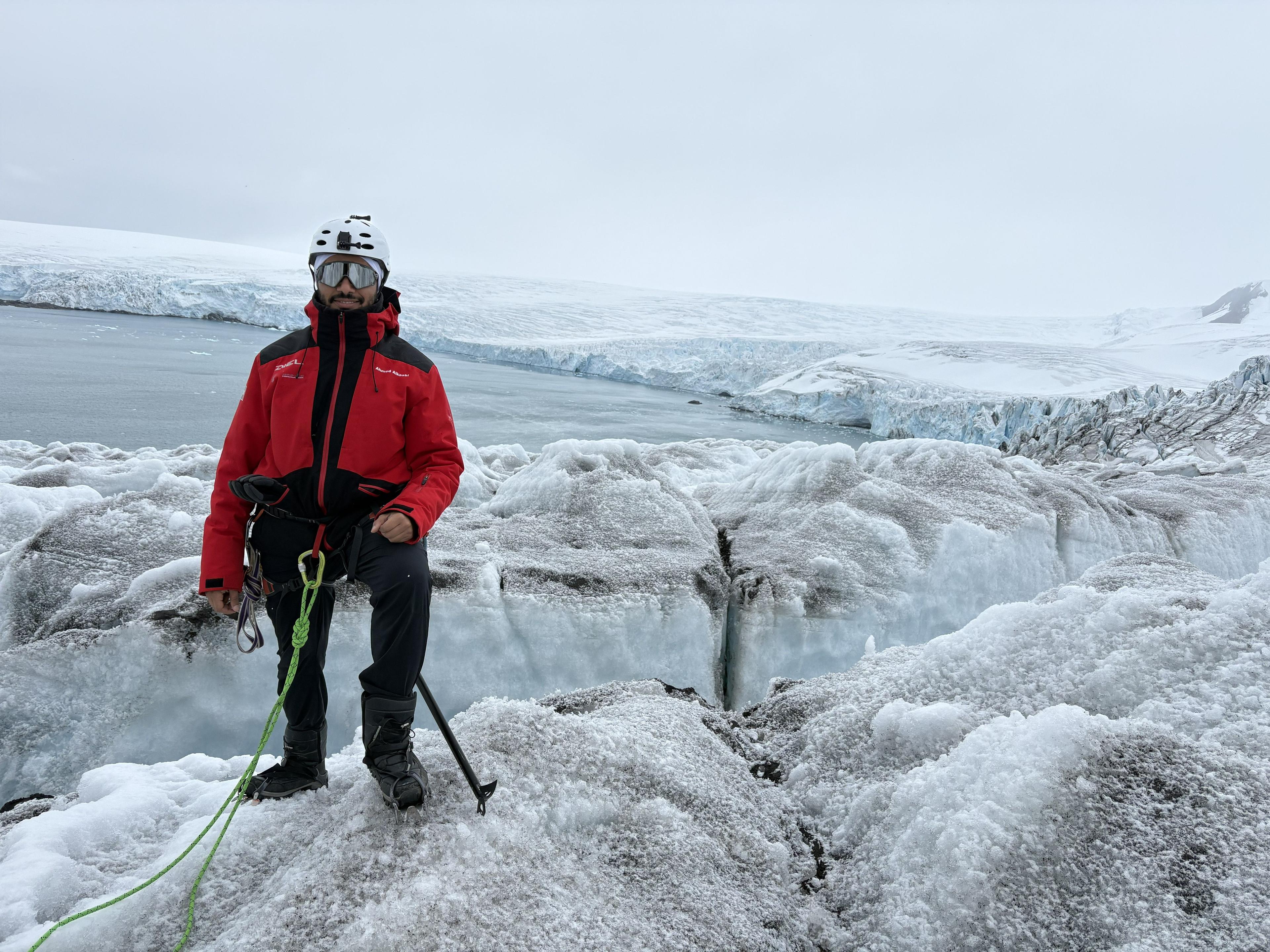 Scientists from the UAE’s National Center of Meteorology are asking, what impact might a rapidly changing Antarctica have on life in the Middle East?

On Livingston Island in Antarctica, thousands of kilometres from the UAE, Ahmed Al Kaabi and Badr Al Ameri have spent hours hauling scientific equipment across the ice, installing instruments designed to measure changes in the atmosphere, oceans, and the earth beneath their feet.
The work of the UAE’s National Center of Meteorology scientists poses a question that sits at the heart of Under the Ghaf, a new podcast from The Climate Tribe: what does a rapidly changing Antarctica have to do with life in the Middle East?
Al Ameri, a geophysicist working in seismology and tsunami early warning, and Al Kaabi, a meteorological researcher, describe Robinson Crusoe-esq expeditions that sound, at times, more like tests of endurance than scientific fieldwork.
Antarctica is home to the vast majority of the world's glaciers and plays a critical role in the global climate system. But, despite its geographic isolation, what happens in such polar regions does not stay there. The continent is connected to the rest of the planet through ocean currents and atmospheric circulation, while changes to its enormous ice sheets have implications for sea levels far beyond its shores.
From Abu Dhabi to Antarctica
Reaching Livingston Island, where the researchers work alongside a Bulgarian Antarctic team, requires days of travel through Brazil and Chile followed by a five-day voyage by sea.
The pair have made the journey twice. Their first expedition, spanning 2024 and 2025, lasted about a month; their second, from late 2025 into 2026, kept them in the region for roughly two months.
Yet despite the demanding journey, both describe being struck by the scale and beauty of the landscape each time they arrive.
Al Kaabi recalls the silence, broken by the cracking, shifting, and chiming of the ice - sounds that, to him, resemble a natural orchestra.
The work begins
The serenity does not make the work easy. Installing scientific instruments can mean spending eight to 10 hours outside, trekking across difficult terrain and transporting equipment, including batteries weighing around 60kg.
And with each expedition, hazards await. For example, the scientists share that on one outing, they encountered a leopard seal roughly the length of their four-metre boat. It followed them for around 40 minutes as they attempted to reach shore.
“She was chasing us around the rock like a shark,” Al Kaabi recalls. “We turned off the engine, calm, not talking, so she would feel relaxed. She felt relaxed after 40 minutes.”
The encounters are a reminder that the researchers are working in a wilderness in which they are the visitors. But even in one of the most remote places on Earth, signs of human presence are difficult to escape.
The scientists describe finding plastic waste, including bottles, among penguin nesting areas, left behind by visitors to Antarctica. They carry bags with them so they can collect rubbish they encounter during their work.
Watching a changing planet
Across two expeditions, the UAE researchers have established weather-monitoring stations alongside seismic and tide-gauge equipment.
The instruments collect information on atmospheric conditions, sea levels, and movement beneath the Earth's surface. Researchers are now analysing the observations, with a first Antarctic climate report planned after they have worked through roughly two years of data.
Their work is also collaborative. Measurements gathered by one station can contribute to different fields of research, while UAE scientists work alongside Bulgarian researchers and the wider international scientific community.
That collaboration matters because Antarctica is not an isolated frozen wilderness whose fate ends at its coastline. Changes in the polar regions can have consequences for sea levels, oceans, and weather systems thousands of kilometres away. Understanding those changes is a critical part of understanding the risks facing countries such as the UAE, a nation already accustomed to extreme heat, but confronting a future in which climatic extremes could become increasingly consequential.
“We need to understand the changes not only within the UAE geographical area,” Al Kaabi says, arguing that researchers must look beyond national borders to understand the changes countries may need to prepare for.
“What we are doing today, we might not see it, but the next generation might see it,” he says.
The Under The Ghaf conversation with the Emirati researchers highlights the importance of cross border collaboration to tackle a changing climate. The measurements taken by the scientists on a remote Antarctic island will contribute to understanding and monitoring seismic shifts and weather patterns globally.
Most Popular



The Climate Tribe delivers stories about topics such as biodiversity and conservation, circular economy, food and water , and how they intersect with climate.
Enquire
Do you have a sustainability story that deserves to be told? Are you driving climate action in your community, or do you know someone who is? Let us know about it at [email protected]
Subscribe
Get the latest stories inspiring climate action around the globe straight to your inbox.