Stop, listen, and reforest
While the world debates climate action, Marie-Noëlle Keijzer acts. As CEO and co-founder of Belgium-based WeForest, she's built a restoration empire on a simple principle: listen to those living with climate change firsthand.
 Through corporate and philanthropic fundraising, WeForest has planted over 100 million trees across threatened ecosystems and supported 600,000 people in underserved regions.

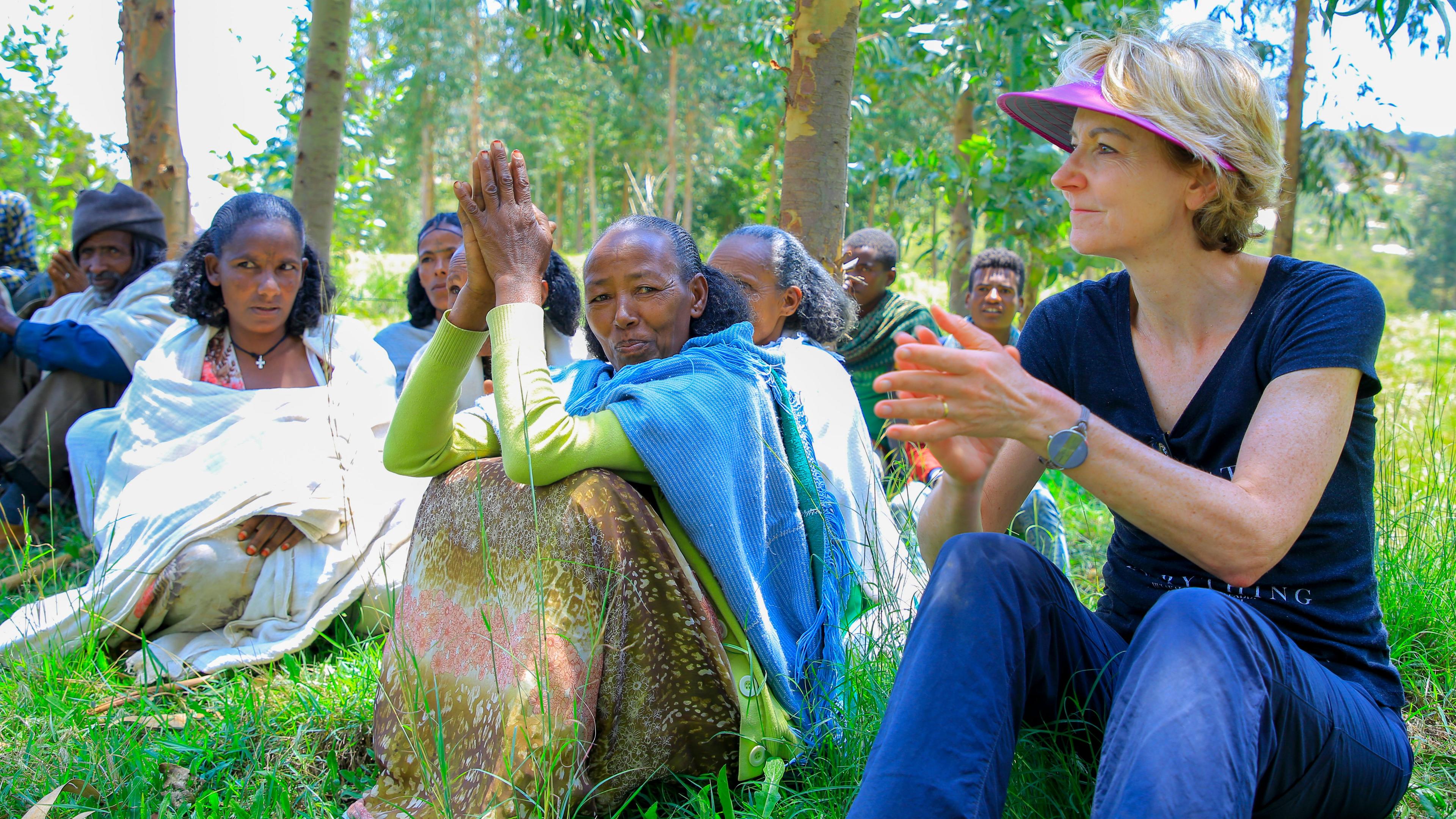
Marie-Noëlle knows she and her team should leave before darkness makes the mountain roads more treacherous. They're in the remote highlands of northern Ethiopia working on forest restoration, visiting communities where entire families survive on less than a dollar a day. But the farmers have urgent stories that won't be rushed – stories that challenge everything the developed world believes about climate expertise.
Here, in one of Earth's most marginalised corners, she finds the planet's most articulate witnesses to climate change – people who understand intimately what rising temperatures, shifting rainfall, and ecosystem collapse actually mean for daily survival.
This contradiction, between material poverty and climate expertise, captures everything that drives Marie: these conversations aren't just community engagement, they're masterclasses in climate reality from those living it firsthand.
Listening is imperative.
Marie’s awakening began in a corporate boardroom in 2006. Watching Al Gore's 'An Inconvenient Truth' shattered her successful career managing global SAP software implementation. “I couldn't believe it was that bad, and I had to do something,” she recalls. “When I'm anxious, I get into action. That's the only way. Otherwise, I go crazy.”
Her corporate life suddenly felt meaningless. She studied environmental science at night, and when her company wanted to relocate her from Europe to the US, she refused; they made her redundant – a liberation disguised as a career setback.
Through her network, she connected with Bill Liao, who had founded WeForest with just a video and a network of scientists. “I said, Bill, I heard you're looking for a CEO – here I am. Everything I've done in my life is to prepare me for this,” Marie remembers. “We hugged, and a week later we were together at COP.”
That 2009 handshake launched what would become a global restoration force. WeForest now employs over 100 people in Ethiopia, Zambia, Senegal, Brazil, Argentina, and at its Brussels headquarters. Through corporate and philanthropic fundraising, they've planted over 100 million trees across threatened ecosystems and supported 600,000 people in underserved regions through income-generating activities like chicken farming and beekeeping, along with training, equipment, and emergency aid during crises.
Their approach challenges conventional thinking about reforestation. “It's not about planting trees, it's about protecting what's existing… It's planning the entire landscape,” she explains. WeForest splits its focus equally: one-third forestry, one-third water and soil restoration, and one-third community livelihoods. The philosophy is simple – understand why land has degraded, address the problem, and ensure communities benefit.
This plays out across three major programs. In the Great Green Wall in Senegal, they learned that previous projects failed because, as Marie puts it, “…if you don't involve and if you don't let the local communities drive, it is not going to work.” WeForest works with pastoralists who need their livestock to graze, creating systems that protect both trees and livelihoods.
Women in Ethiopia – often single mothers after men left for construction work abroad – now double their daily income through chicken farming and beekeeping, with the organisation providing training, equipment and guidance, with priority given to the most vulnerable families.
Their Blue Carbon program tackles a different challenge. In Senegal's coastal regions, they restore mangroves, nature's most effective carbon sequesters, which protect against storms while enabling fishing and oyster farming to return. When mangroves disappear, productive waters turn to mud; when restored, communities can work again.
In South America, they tackle a crisis few know exists. While everyone focuses on the Amazon, Brazil's Atlantic Forest – home to over 23,000 plant species, half of them found nowhere else on Earth – has virtually disappeared. In most places, only 3% remains. WeForest creates corridors connecting isolated patches so jaguars and other endemic wildlife can move and breed, while Brazilian women now run profitable tree nurseries supplying the restoration.
Across all programs, results are tracked precisely through community involvement. WeForest was the first NGO to GPS-map every tree planted. Camera traps capture returning jaguars, while recycled smartphones use AI to catalogue the sound of species and how quickly ecosystems heal.
This commitment comes at a cost, and Marie harbours no illusions about mounting challenges. Corporate funding faces headwinds as companies grow cautious amid media criticism of nature-based solutions,
Yet Marie grounds her hope in stark mathematics. She shares a startling statistic: insurance companies paid out over 400 billion dollars for climate damages in 2024 alone. The annual cost of the forest restoration needs to meaningfully address climate change? Just 11% of that amount, sustained for 20 years.
“We have the answer to the world's biggest problems – climate, biodiversity loss, poverty, soil erosion,” Marie insists. Stopping deforestation and forest restoration could reduce atmospheric carbon by 25%, possibly much more according to recent research by NASA focusing on the water cycle impact on climate. Stop deforestation and plant strategically, she argues, and cooling could happen as rapidly as today's warming.
Her relentless advocacy stems from a profound sense of duty. From Davos to London, conference after conference, she remains undeterred. “Sometimes people might think I'm crazy... but I feel like if I don't do it and other people like me don't do it, who's gonna do it?”
To critics who argue reforestation efforts are imperfect, Marie's response is direct: “Not everything's perfect because restoring the environment is a complex science, and we work in very remote areas, with difficult access. But at least they're trying something. Otherwise... That's it. We're fried.”
What sustains her? Working with passionate people united by a cause bigger than themselves. Whether partnering with Ethiopian farmers who understand climate change better than most scientists, or convincing corporate executives to fund landscape restoration, she finds hope in human connection and shared purpose.
When asked whether she's optimistic or pessimistic about the future, Marie gives perhaps her most revealing answer: “I don't want to ask myself. I just do. I just try to work harder and see if I can get something over the line.”
In a world paralysed by climate anxiety, Marie-Noëlle Keijzer embodies a different approach: listen first, then act. She's proving solutions exist in the voices of those living climate change firsthand – if we have the courage to hear them and implement what they teach.
Most Popular


The Climate Tribe delivers stories about topics such as biodiversity and conservation, circular economy, food and water , and how they intersect with climate.
Enquire
Do you have a sustainability story that deserves to be told? Are you driving climate action in your community, or do you know someone who is? Let us know about it at [email protected]
Subscribe
Get the latest stories inspiring climate action around the globe straight to your inbox.