The Case of the Missing Lake
Lake Ballona goes missing, and only the mushrooms can help.
 Illustrator: Nicole Xu
Imagine 2200, Grist’s climate fiction initiative, celebrates stories that offer vivid, hope-filled, diverse visions of climate progress. Discover more cli-fi collections. Or sign up for email updates to get new stories in your inbox.
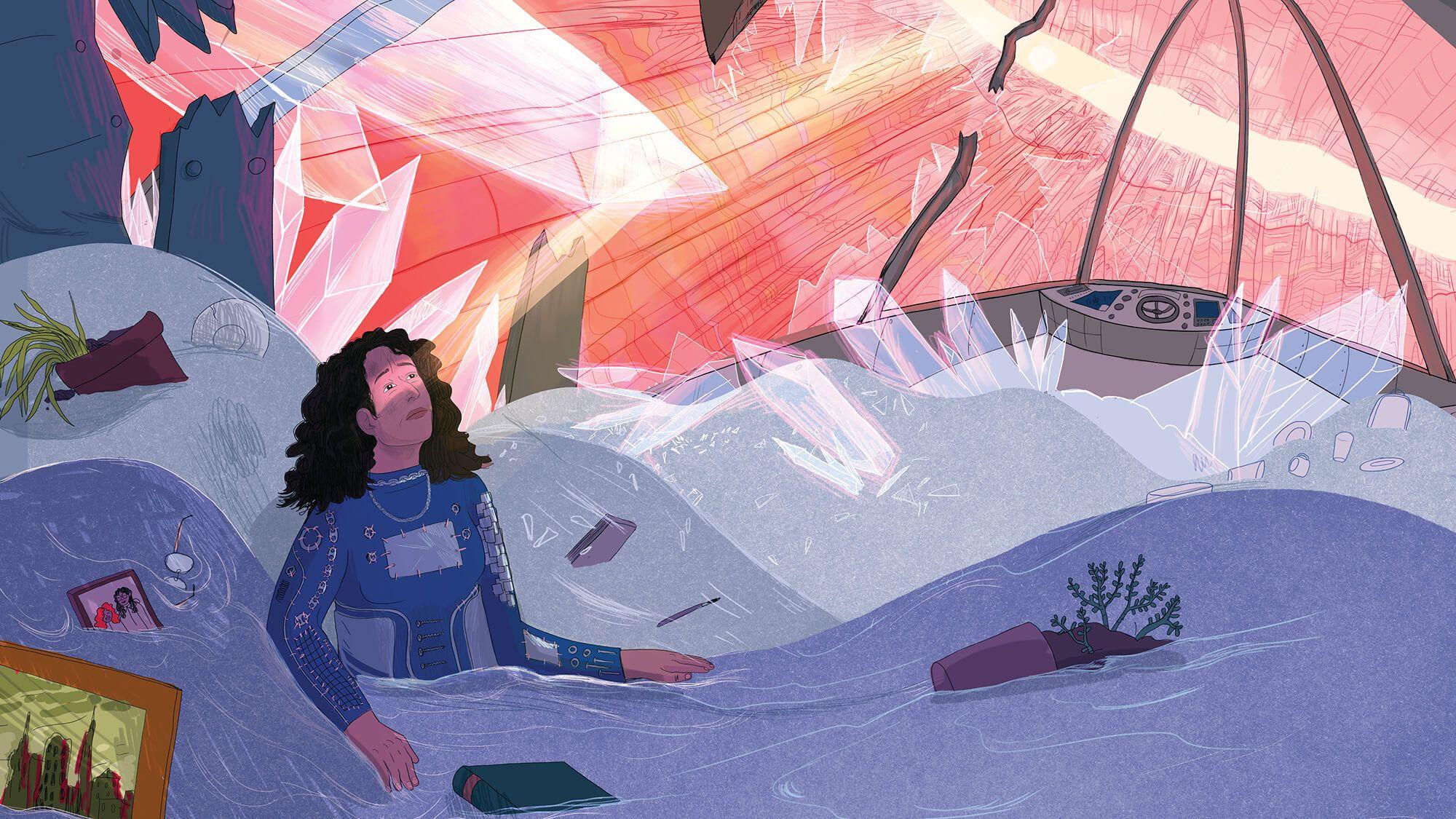
On the morning of April 8, 2200, Lake Ballona went missing. A pair of hikers ventured down from the Hollywood Hills on a day excursion into the Tongva Wetlands. Where the area’s largest body of freshwater met seawater to create a brackish habitat, they discovered an empty crater. Lake Ballona was gone. Vanished overnight. Only muddy puddles remained where the lake had swelled the day before. There were no signs of violence.
How could an entire lake have disappeared so suddenly? The weather had been placid. No earthquake had occurred that might have caused a fissure in the lakebed. Ballona Creek, the lake’s freshwater source, remained flowing. This creek, which meandered east to west through the urban area into the liminal zone, was the pride of Los Angeles. Even though it was dammed at Culver Lake — the upstream urban sister of Lake Ballona — the creek always flowed. The waterway was fed by a network of solar-powered rain and marine layer capture systems that surpassed in efficacy and ingenuity even the finest Roman aqueducts.
A few overimaginative newscasters speculated that an army of electric blimps might have conducted a secret nocturnal raid and scooped out the lake’s water. This action movie fantasy was, of course, absurd. With the best desalination plants and water capture systems in the country, Los Angeles had not suffered a water shortage in over a hundred years.
Nonetheless, almost everyone, including me, was convinced that there had been foul play.
This was the season of our rezoning. It always brought mishap.
The fifty-fifty rule (where fifty percent of the country was allocated to wilderness, and fifty percent to built environments) always remained undisputed. But every seven years zoning in the liminal zones was up for reevaluation. The liminal zones were the wilderness areas that bordered the urban areas. We rotated them in and out of each zone like crops. In other areas of the country rezoning was a stable affair. But we Angelinos lived in an erratic alluvial flood plain. It fanned out over the desert and collided with tidal wetlands. We were a people and a land on the move. Our rezoning was perpetually fraught. And the politics it engendered were fierce.
I kept waiting for a political group to claim responsibility. To use the lake’s disappearance as justification for some wacky rezoning. But no one stepped forward.
It was a mystery. A classic whodunit.
So, we called in the Mushroom Translator.
Erlyt Torre, California’s top mycorrhizal linguist, padded into my court. I leaned over my bench to take in her tiny frame. She looked up at me and smirked, aware that her reputation was as formidable as an earthquake. Though only 25 years old, Erlyt had helped Endosym Communications develop the state-of-the-art mycorrhizal translator she lugged. Under her guidance, our knowledge of this region’s mycorrhizal vocabulary had increased from fifty to 3,330 words. She was Tongva, educated in the traditional knowledge by her parents who ran the Tongva Wetlands Caretakers Association. I had gone to graduate school with her mom and had known this dynamo kid since she was a zygote — long before she renamed herself Erlyt, the fungal word she says means to thread.
“Good morning, Honorable Mediator Baldwin,” she mumbled, slurping on a root tea.
“Aw, come on,” I replied.
Years ago, when the courts switched from anthropocentric to Earth jurisprudence, mediators replaced judges. It made no sense in a non-binary approach to justice to have a single judge decide a case. To elevate the role of mediators to the status formerly granted judges, the courts kept some of the old trappings. Our offices were called chambers, our courtrooms remained elegant, and we were given robes. Erlyt thought that these formalities were stupid.
“Paloma,” she said.
“I’m glad you’re here. Any leads on the culprit?”
She set her arms akimbo. “How do you know there has been a crime?”
“Lakes don’t just up and leave,” I said.
Erlyt cocked her head. “Well, the fungi should know something.”
I stepped down from my bench. “How long do you think it will take?”
“Being able to identify 3,330 words in the predominant mycorrhizal language of this region does not mean we understand what the fungi are saying,” she said. “Their language is all verbs.”
She had given me this lecture before. I could not even imagine communicating in a language that had no nouns.
“Do you think you’ll have something by tomorrow?”
She whistled through her teeth. Her eyelids shimmered with iridescent mycelium dust, a cosmetic of the wetlands. “That’s a rush.”
“The election is in two weeks.”
“I’m well aware.”
“Lake Ballona’s disappearance will turn into a political shitshow if we don’t locate the culprit.”
Erlyt squinted at me. “Is this about the Humblens mediator gunning for your job?”
“I’m projected to win,” I said, helping her secure her backpack.
My opponent was a member of the rightwing Humblens party that traced its roots back to last century’s resistance party against the fifty-fifty land movement. They were proudly anthropocentric, believing that humans were the superior species and needed to embrace their dominion over “nature.”
“The Humblens are gods, you know,” she said sarcastically. “They should be free to roam the wilderness.”
We chuckled, bonding over our shared belief. We both knew that one person’s wilderness was another person’s home. And that every environment was in some sense “built” as well as natural.
Like most mediators, I identified with the majority Sumbions party, committed to fostering beneficially symbiotic and intersectional relationships among all beings. Erlyt was a member of the progressive Curiens party, favored by residents of the wilderness zones, who believed that we Sumbions were still too anthropocentric.
I accompanied her out of the courtroom. Perched on Baldwin Hill, the courthouse overlooked Culver Lake. As we watched the boaters, my heels sunk into the spongifying courthouse steps.
“Damn,” I murmured, transferring my weight to my toes.
I chastised myself for wearing my good heels two weeks before the spraying. Everything was already softening, readying for its scheduled disintegration.
“Not a wise fashion choice right now,” Erlyt commented.
This neighborhood bordered a liminal zone, which meant that its building materials had to be not only biodegradable, but to actually degrade at the end of seven years unless sprayed. The spraying was scheduled for right after the election when we would know which areas would be put into the liminal zone and which would remain urban. The crops and wildflowers always flourished in this time because the organic enzymes released by the spraying nourished the soil. The humans were less welcoming. No matter how predictably it came, people did not like change. Over the years, we had improved in our responses, though. An entire cottage industry now serviced this transition time. There were cultural ambassadors, therapists, and replacement specialists who ensured that everyone was properly rehomed and that communities remained intact.
A gust of hot air swirled around my robe. Grit settled on my tongue. Erlyt skipped down the steps to catch the electric tram. It would take her half a day to reach the crime scene.
“Good luck,” I called out.
She waved. I bit my lip. Once Erlyt was on a case, she fell into “mushroom time” and lost all sense of human deadlines. My stomach fluttered, anxious. If we were not unified by the time of the spraying, our democracy would fray.

One week after the disappearance, Erlyt located Lake Ballona’s remains.
The chattering in the mycorrhizal network at the empty lakebed had been overwhelmingly loud. It had taken Erlyt several days to home in on the relevant conversations. The acoustic commotion of a fungal colony gossiping about new food had provided her with clues. These conversations led her to a mound of mud in the middle of the crater. With the aid of sonic cameras, she and her team located a fissure underneath this mud that was invisible to the naked human eye. At the bottom of this fissure, a massive fungal colony feasted on a decaying oil derrick. Beneath the derrick, pooling among the ruins of an ancient oilfield, swirled the remains of Lake Ballona.
We now knew where the lake had gone, but we could not agree upon the culprit.
Lance Lavonia, the Humblens Party Chair, got the District Attorney to file a complaint with the court. “The City of Los Angeles vs. Tongva Wetlands Fungal Network” claimed that the fungi had committed ecocide on Lake Ballona.
“We can’t let them get away with it,” Lance Lavonia declared. “We need to rescue Lake Ballona.”
“How?” a reporter asked him. “Are you going to drill down and pull that water out of the earth?”
He grinned. “Whatever it takes.”
Lance Lavonia was a blowhard.
Protestors asserted that Los Angeles had no right to file this suit because the city included not just humans but all animals, plants and minerals who also had rights. The Party of the Animals and the Botanicus Party jointly filed an amicus brief (“Tongva Wetlands Fungal Network v. the City of Los Angeles”), claiming that if the fungi wanted to eat the decaying derrick, they had every right to do so.
It was a core principle of our Earth Jurisprudence that we aimed for win-win solution to conflicts. But this case threatened to do us in.
As the head of our five-person mediation council, it was my responsibility to select the location for the mediation. This was easy. In land cases, it was customary to conduct the mediation at the location of the dispute. The welfare of all parties in the ecosystem had to be considered, human and nonhuman. The land and its residents had to be present at the hearings and we humans had to be present in the land. Our three-day mediation would be held at the remains of Lake Ballona.
All of us mediators then chose who would participate in the mediation. We selected stakeholders from each political party that had expressed an interest in the case, as well as community organizers from the urban neighborhoods bordering the liminal zones, along with residents in the liminal zones including samphire farmers, scientists and especially our hosts, members of the Tongva tribe. These wetlands were their ancestral homeland, and they were its primary caretakers.
On the appointed day, the Tongva Wetlands Caretakers Association gave our crew of twenty-four camping passes and passage to the former lake. Erlyt was appointed by her parents to be our official Tongva host.
We traveled in three small boats for several hours, wending quietly through the wetlands. I had not been out here since I was on a field trip in elementary school. The place was wilder than I remembered, more dynamic and alive. Intricate scales of sounds, shapes, and colors saturated my senses. My hair swelled in the saline air. Birds cried and sang. Without the vantage of a vista to orient myself, I was lost in the rough grass. We were fortunate to have Erlyt’s guidance. No GPS could accurately track these labyrinthine waterways.
“We shape the land as it shapes us,” she remarked to us. “Do you notice that in this channel the water is clearer, and the banks are crisper? This is because of human movement through the water.”
“Is that a good thing or a bad?” I asked, inhaling the salty air.
She scanned the waterways. “It’s a responsibility. Humans are a keystone species. Without our water capture systems, we wouldn’t be able to deliver enough freshwater to maintain these wetlands.”
We came to a shore and tied up the boats. My hiking boots caked with mud as I walked over a small mound of woven grass. The bare lakebed spread before us. Sand pipers and gulls picked at the newly exposed floor. My jaw dropped. I had watched the footage of this vanished lake but experiencing it in person brought a wave of astonishment. So much had disappeared so quickly.
To the east across the wetlands, L.A.’s living buildings glistened with bright green growth. Behind them in the distance loomed the brown peaks of the San Gabriel Wilderness Area.
Erlyt led us to the western side of the empty crater where the ocean tides caressed the grass.
“Welcome to the ancestral land of the Tongva,” she said, after we had all assembled. “We weathered the colonization of the Spanish in the 1700 and 1800s. We endured the decimation of our lands by oil drilling that started in the 1930s. We mourned the paving over of our home and heritage with the development of Marina del Rey, Venice, and West Los Angeles. After the great sea rising of the last century, we welcomed the restoration of our lands and the return of many species. We also grieved for those who never made it back.”
Erlyt swept her arm in the direction of the ocean. “We stand near what was once Waachnga. One of our ancestral villages before the Spaniards came.”
“Waachnga,” I repeated, letting the sounds settle in my mouth.
Erlyt walked us to the middle of the crater where the water had slipped away. The modest depression gave no indication of the phenomenon that had recently transpired. Brine flavored my tongue. I imagined the fungi feasting below us decomposing old exuberances and defilements.
There was so much I did not know about this land, even though I stood in it.
That evening our group assembled around a campfire. I began our first mediation session by invoking Thomas Berry, the 20th century environmentalist who coined the concept of Earth Jurisprudence.
“Every component of the Earth community has three rights,” I said, quoting Berry. “The right to be, the right to habitat, and the right to fulfill its role in the ever-renewing process of the Earth community.”
Our council followed a standard mediation protocol: three hearings over three days. The first session focused on letting everyone air their grievances. In the following sessions we focused on resolving the conflict. Airing grievances was usually contentious, but I found that people needed to go through this process before they could start to think creatively about a win-win solution.
“Who would like to speak first?” one of my colleagues asked.
I was not surprised that the Humblens Party Chair raised his hand.
“The fungi murdered the lake,” Lance Lavonia said. “They’re dangerous and need to be stopped. If we convert more of the wetlands into an urban zone, we can contain them.”
Viveka Nida, the Sumbions Party Chair squirmed.
“The fungi are doing us a favor,” she retorted, her face flushed with anger. “It’s the fault of our forebears who committed the crime of drilling in a wetland and then left a mess. We should be grateful to the fungi for eating away the waste. I think we should encourage them to decompose all the garbage buried under L.A. by expanding the liminal zone.”
Many members of the group murmured in agreement.
“Whose fault is this?” the community organizer from Inglewood asked. “That’s what I want to know.”
“It’s the fungi!” Lance said. “Obviously. You can’t blame our ancestors.”
The Botanicus Party Chair spoke. “You don’t know the intention of the fungi. Or the lake for that matter. This lake had every right to disappear if it wanted to.”
Lance’s upper lip curled in contempt. “How do you know it wanted to disappear? Maybe the mushrooms killed it. Maybe it wants us to administer justice.”
Viveka groaned. Her displeasure was echoed by others.
Lance glanced at her, appearing to enjoy provoking his opponents. “If it were up to me, I’d use some of our fine technology to coat the bottom of this crater so that it doesn’t leak again. It’s the only way you’re going to save your lake. If you don’t want to do this, fine. This is the liminal zone. But if these fungi start doing the same thing in the city, I won’t stand for it. Not under my watch. I’ll nuke em.”
“We can’t kill them!” Viveka said, bolting upright.
“What happens if we just leave it as it is?” I suggested.
The Inglewood community organizer growled. “If we do nothing, the ocean will take over these wetlands and we’ll have to build a retaining wall. Storms will increase in intensity. Floods will ruin the city.”
“Maybe the city should retreat a little,” the Curiens Party Chair suggested.
The crowd erupted in uproar. I swapped glances with my fellow mediators. This was going nowhere fast.
I raised my hand. “Let’s adjourn for the evening. In tomorrow’s session, I’d like you to discuss your ideal solutions to the problem. Here’s a question to consider: Are we here for the lake or is the lake here for us?”
After the meeting disbanded, I tamped out the fire.
“Are you still looking for a culprit?” Erlyt asked me.
I looked up, startled by her presence.
“Maybe,” I replied.
The solutions that people proposed at the next evening’s session were all win-lose. None of them was worthy of being sent to the simulators, who could program visual simulations of almost any scenario. I was disappointed, but not surprised.
Viveka spoke first. “I speak on behalf of sixteen of us here. Preserving the Tongva Wetlands is important not just to the people and other species who live here. It is also an important historical and cultural site.”
Her allies nodded their heads.
She continued. “To save it we need to bring more freshwater to the area. Let’s get water from the city and direct it to replenishing the lake.”
“How?” Lance interrupted. “We don’t have enough water for that without taking it away from something else.”
“Let me finish, please. I’m getting to that,” she said. “We want to undam Culver Lake. Then move it and Ballona Creek into the liminal zone. If we direct the water from Culver Lake to Lake Ballona, we can save the wetlands — which is something I think we all want.”
Lance balked. “You want to kill our most popular lake? And shrink our city?”
“We won’t have much of a city if we don’t save the wetlands,” Viveka warned.
“What do you propose?” I asked Lance.
“We have a plan,” he said, glancing at his fellow Humblens. “Rezone Ballona Lake into the urban area. Build a retaining wall against the sea. The lake is gone anyway. Why not put the space to good use?”
“And lose the wetlands?” Viveka cried out.
The entire group began to squabble.
I clapped my hands to get their attention. “What is it that you truly want?”
“We want our lake,” Lance and Viveka said simultaneously, though they meant different lakes.
“What is it about your lakes that you want?”
They grew silent.
“What might be a third solution?” I asked.
Lateral thinking was one of my favorite tools in the craft of mediation. Whenever there was an argument between two sides, it was helpful to find a third side.
No one spoke. I felt the stony weight of the impasse. After an hour of failed attempts to unstick ourselves, we gave up and I ended the meeting.
“Here’s another question to consider before tomorrow’s session,” I said, working to stay positive. “How would a lake think about this problem?
They scowled at me as we adjourned.
How did a lake think? Snuggling into my sleeping bag that night, I examined the stars and pondered my own question. The mud plumped and hardened under my back. My pores filled with ocean air.
Water followed the path of least resistance. Through persistence, it could change the shape of a boulder. To a lake, I imagined, water was a verb.
When my forebears made water an object, they ran out of it. They stole it from the Owens Valley, snatched it out of the Colorado River and yanked it across the highways to sell it as a commodity. They pretended it was a thing that could be fixed — bottled, filtered, priced. Then the ocean rose to take us over. To push us back. Keep us at bay. Water seeped through our wounded soil and buried our bad behavior, flooding the remains of our extractions, leaving us to stew in our toxic brew. It made us migrants, reminding us that we were motion, more verb than noun. More water than solid. We sloshed.
When I awoke on the third morning and returned to the campfire, Erlyt was gone. She had left us a message on our devices: Check the news. You need to make a decision pronto.
We gathered and snapped into the news. There on the screen, I saw Erlyt staked out at Culver Lake with her Endosym translator. The air clouded with particulates stirred up by the movement of spectators. Three days remained until disintegration.
Erlyt mounted a podium to face reporters. “Culver Lake is slowly draining.”
I yelped.
“It’s not because of the fungal network,” she said. “We see no evidence of feeding fungi, nor have we detected any subterranean shifts that have caused a fissure. It appears that this lake just wants to go.”
I stepped away from the news and turned to face the remains of Lake Ballona. Gulls squawked overhead arriving from the ocean. Erlyt had been right. There had been no crime. There was no culprit. The lake was simply gone, leaving us to find ourselves.
I walked to the crater’s western edge, speculating on where Culver Lake was going and if it would join Lake Ballona. The seawater was becoming a more confident visitor. Instead of entering in shy rivulets, it now greeted the crater with exuberant splashes.
“Paloma,” Lance called out.
I waited for him to join me.
“Good morning, Lance.”
“We’ve come up with a solution,” he said. “In light of the circumstances, I wanted to share it with you now.”
I braced myself for a screed.
“We agree to cede Culver Lake to the Tongva Wetlands,” he declared. “Unfortunately, we would have to expend more energy than it’s worth to save it. The land is moving against our wishes.” He stared at his boots and heaved a sigh. “Put the entire area in the liminal zone. We’ll move the city farther south.”
I went slack-jawed, astonished at his turnaround.
“No!” a woman cried out.
Viveka stood behind him. Lance whirled around to face her.
“You win,” he said. “We’re letting you win.”
“Not so fast,” she replied. “We were about to concede to you.”
Viveka glanced at the crater’s edge. “The ocean is already here. If we don’t build a retaining wall, we’ll lose too much of the urban zone. We agree to shore up Culver Lake and cede Lake Ballona to the urban zone.
“Let’s discuss this with the group,” I said, recovering from my surprise. “What if you both conceded? What would it be like if we undammed and moved Culver Lake into the liminal zone and also moved Lake Ballona into the urban area?”
“Flip the zones?” Lance asked.
The group agreed that the proposal was worthy of sending to the simulators. Hours later the simulations we got back seemed promising. The water released from Culver Lake would give Lake Ballona the needed influx of freshwater to bolster the wetlands. The increased wetlands would be strong enough to support a seven-year surge in human population if we lived gracefully on the land. Additionally, the reduced human population in the Culver Lake area would let us redirect the freshwater in that area so that we could expand those wetlands.
We returned to the city, resolved. Viveka Nida and Lance Lavonia presented our solution as a united front.
Only after we held the elections, sprayed the buildings, and carried out the rezoning; only after we undammed Culver Lake and refashioned our water catchment systems; only after we uprooted and replanted ourselves did we experience what really happened. What our simulators had predicted came only partly true. Culver Lake did flow to Lake Ballona, but then it kept moving on, deeper into the wetlands, closer to the ocean. A new lake settled slightly west of where Lake Ballona had been. Its belly settled directly above what had once been the site of the ancestral Tongva village.
Erlyt laughed when she realized this. “Lake Ballona just renamed itself. Its new name is Lake Waachnga.”
The land surprised us, and we followed.
Most Popular
The Climate Tribe delivers stories about topics such as biodiversity and conservation, circular economy, food and water , and how they intersect with climate.
Enquire
Do you have a sustainability story that deserves to be told? Are you driving climate action in your community, or do you know someone who is? Let us know about it at [email protected]
Subscribe
Get the latest stories inspiring climate action around the globe straight to your inbox.