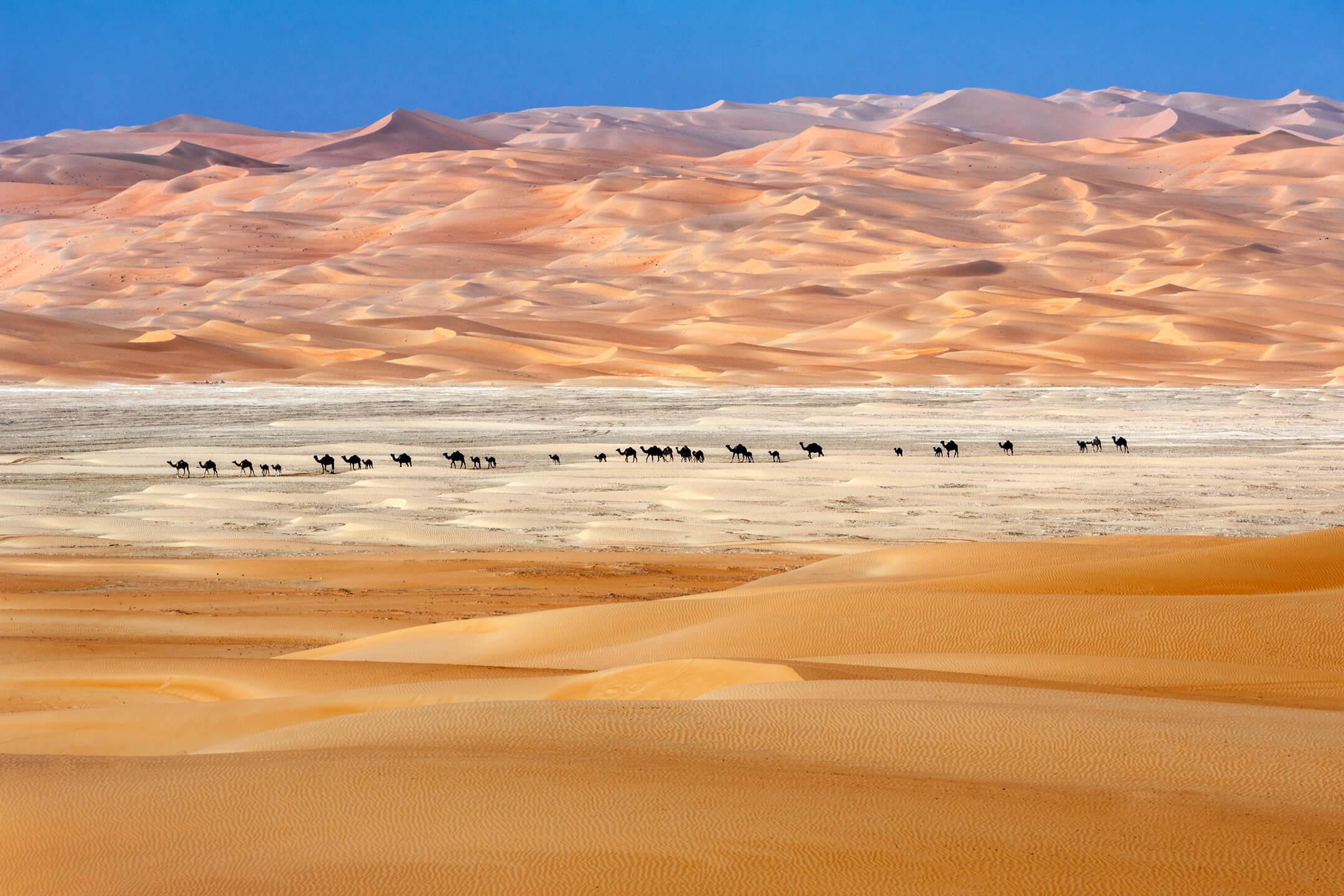
 A caravan of camels traverses the wind-carved, colourful dunes of the world’s largest continuous spread of desert, the Empty Quarter or Rub’ Al Khali.
Photographer: Eric Perales Location: United Arab Emirates
A caravan of camels traverses the wind-carved, colourful dunes of the world’s largest continuous spread of desert, the Empty Quarter or Rub’ Al Khali.
Photographer: Eric Perales Location: United Arab EmiratesThe UAE is home to breathtaking, sun-kissed desertscapes that date back millions of years. Its ancient sands glow orange, red and golden under crisp blue sunny skies, shaped by the careful brushstrokes of the region’s wind.
South-west of Abu Dhabi, you can find one of its gems of natural beauty - the world’s largest continuous spread of desert, Rub’ Al Khali or the Empty Quarter, renowned for its stunning, ever-shifting landscapes and magical Milky Way night views. The Liwa Oasis in Rub’ Al Khali is also the ancestral home to the most numerous tribe in the UAE - the Bani Yas tribe. Nurtured by an ancient water table, the Liwa Oasis’s blooming green date palm groves extend for more than 100 kilometres and have some of the world’s largest sand dunes, like the Tel Moreeb, which towers over 300 metres.
While separating minerals, desert wind can create stripes of different sand colours, reminiscent of the horizontal stripes of flags. On this UAE Flag Day, we invite you to open yourself to the natural wonders of the UAE. Binding together horizontal stripes of green, white and black, the UAE flag’s vertical red band represents hardiness, bravery, strength and courage - all of which are ingrained in the resilient communities and ecosystems that adapted to live in desertscapes. How can we learn from those who adapted to live in harmony with challenging landscapes?
This award-winning photograph was shortlisted in the Planet Category of the COP28 Photography Competition, a collaboration between The Climate Tribe and the Hamdan bin Mohamed bin Rashid al Maktoum International Photography Award (HIPA). The Climate Tribe has partnered with HIPA to leverage the power of photography to inspire global awareness of sustainability and advance climate action.
Most Popular
The Climate Tribe delivers stories about Biodiversity and Conservation, Circular Economy, Food and Water , and how they intersect with climate.
Subscribe
Get the latest stories inspiring climate action around the globe straight to your inbox.
Related Articles