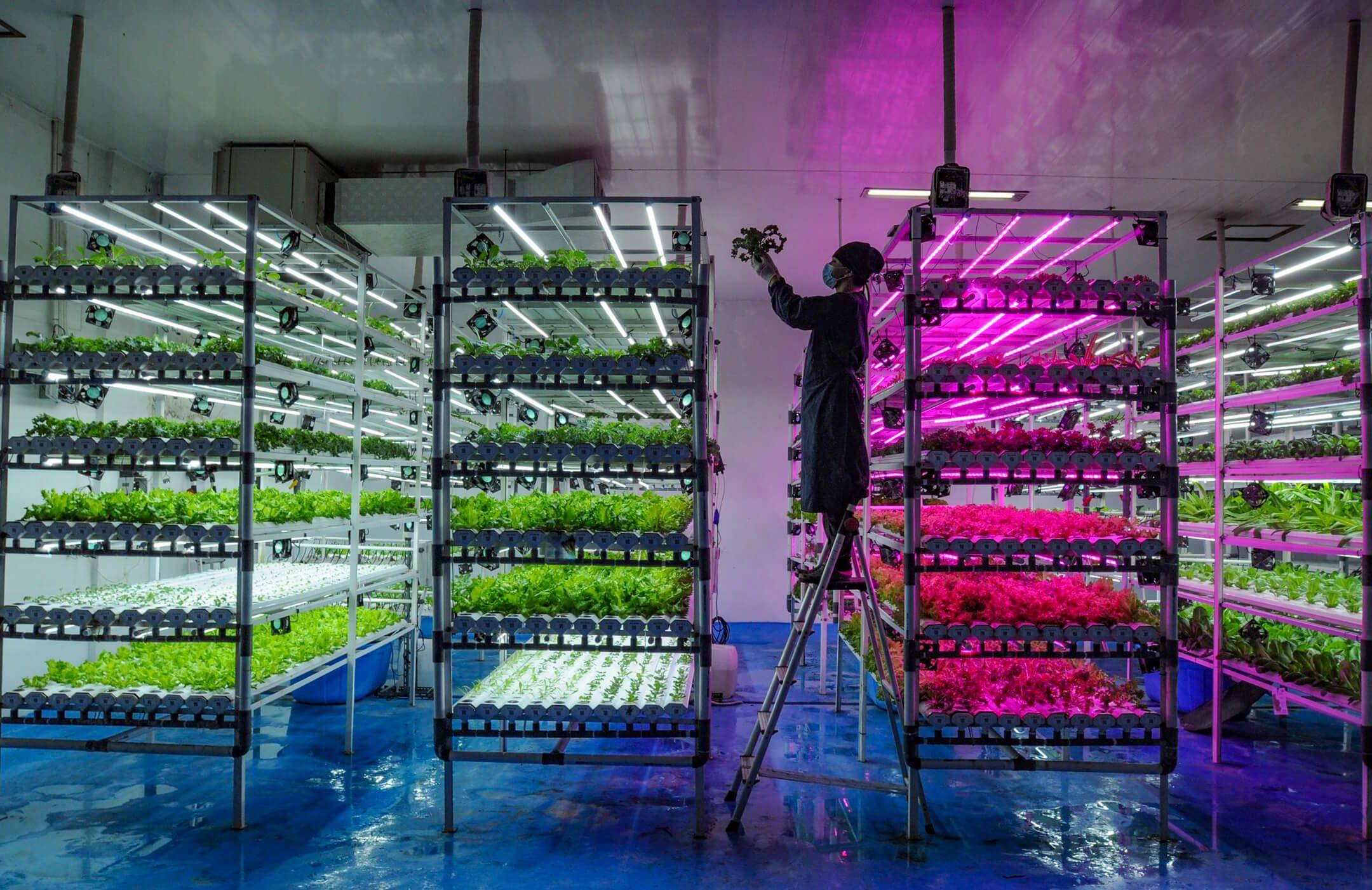
 Perched on a ladder, an officer inspects fresh blooms of leafy green vegetables ready for harvest from a vertical farm in Depok, West Java.
Photographer: Arie Basuki Location: Indonesia
Perched on a ladder, an officer inspects fresh blooms of leafy green vegetables ready for harvest from a vertical farm in Depok, West Java.
Photographer: Arie Basuki Location: IndonesiaAs the world population rises amidst resource constraints, the question of feeding the world efficiently is central to our future.
While the UN has specified Sustainable Development Goal 2 as Zero Hunger by the year 2030, its Food and Agriculture Organisation has warned that the world is significantly falling short of this target. A staggering 2.33 billion people globally faced moderate or severe food security in 2023.
Nevertheless, new green technologies have bloomed to meet the challenge of ensuring global food security. Vertical farming, an innovative agricultural method that grows crops in stacked layers within controlled environments to optimise plant growth, can use up to 98% less water than traditional agriculture. By using optimal lighting and maintaining precise temperatures, farmers can produce healthy, pesticide-free crops anywhere – even in urban centres. (Read our article about The Food Engine (now held under Al Suwaidi Farm), a UAE-based organisation working to make aeroponic farming accessible.)
On this World Science Day for Peace and Development, we invite you to consider (and even innovate!) the technologies that will nurture our pathway to a sustainable, healthy future for all. This year's theme is Trust, Transformation, and Tomorrow: The science we need for 2050. Which transformative green technologies power your vision of an ideal world?
This award-winning photograph was shortlisted in the Solutions Category of the COP28 Photography Competition, a collaboration between The Climate Tribe and the Hamdan bin Mohamed bin Rashid al Maktoum International Photography Award (HIPA). The Climate Tribe has partnered with HIPA to leverage the power of photography to inspire global awareness of sustainability and advance climate action.
Most Popular
The Climate Tribe delivers stories about Biodiversity and Conservation, Circular Economy, Food and Water , and how they intersect with climate.
Subscribe
Get the latest stories inspiring climate action around the globe straight to your inbox.